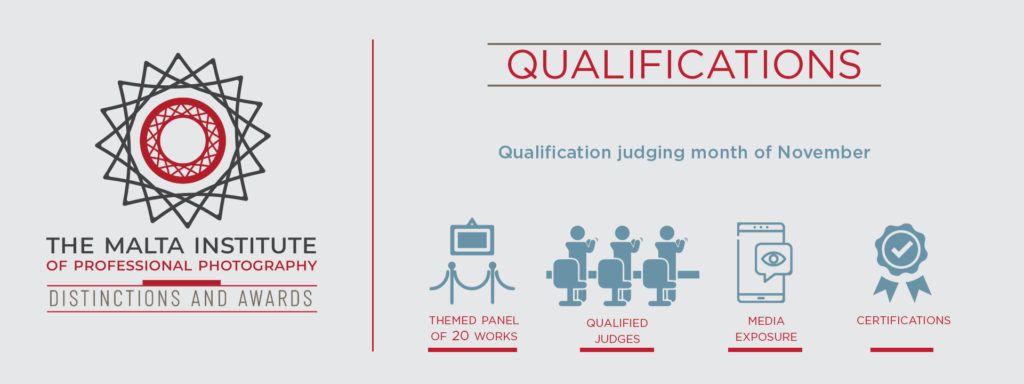
The Malta Institute of Professional Photography (MIPP) offers a structured qualification framework designed to recognise and promote excellence in photography. These qualifications assess technical proficiency, creativity, and contribution to the field, ensuring that members achieve a high standard in their photographic work. The framework consists of three progressive levels: Licentiate (LMIPP), Associate (AMIPP), and Fellow (FMIPP). These qualifications are designed to reflect the professional standards set by international bodies, ensuring that MIPP remains in line with the highest industry benchmarks.
Licentiate (LMIPP)
The Licentiate (LMIPP) is the entry-level qualification, aimed at photographers who demonstrate a solid foundation in photographic technique, composition, and visual storytelling. This qualification is ideal for those who are developing their professional identity and wish to gain recognition for their technical competence. The Licentiate qualification ensures that successful candidates have the necessary technical skills to work professionally in photography and sets a benchmark for future progression.
- Assessment Criteria:
- Technical competence (correct exposure, sharpness, composition, etc.)
- Consistency in quality and style
- An understanding of lighting, composition, and subject matter
- Basic post-processing skills
- A professional approach to presentation
Associate (AMIPP)
The Associate (AMIPP) represents a significant step forward, recognizing a higher level of technical expertise, creativity, and artistic interpretation. The Associate qualification is awarded to photographers who demonstrate a strong artistic vision and the ability to create a cohesive and compelling body of work. Applicants must hold the Licentiate qualification or provide evidence of equivalent experience in professional photography. This qualification is suited for those looking to establish themselves as professionals in the industry, highlighting their expertise in a chosen field.
- Assessment Criteria:
- A consistent personal style that shows artistic and conceptual depth.
- Advanced technical competence – lighting, exposure, composition, and post-processing must be to a professional level.
- A higher level of storytelling or impact, depending on the photographic genre.
- A distinctive personal style and artistic maturity.
Fellowship (FMIPP) – Print Only
The Fellowship (FMIPP) is the highest distinction awarded by MIPP, recognizing photographers who have made a significant contribution to the art and profession of photography. This qualification is reserved for individuals whose work displays not only technical excellence but also a deep understanding of photographic artistry and its impact on visual communication. Candidates must submit a body of work that demonstrates mastery in photography and artistic expression. This requires a portfolio of images, with a strong emphasis on consistency, originality, and exceptional craftsmanship. The work should reflect a well-developed and unique photographic voice, positioning the applicant as a thought leader within their genre. The Fellowship is aimed at photographers who push boundaries, innovate within their field, and contribute significantly to the advancement of photography as an art form.
- Assessment Criteria:
- Mastery of technical and artistic elements in photography.
- A clear and unique photographic voice.
- Evidence of innovation—the work must go beyond technical skill and show unique vision or influence in photography.
- Flawless technical execution, with every image demonstrating complete control over lighting, composition, and storytelling.
Categories
MIPP qualifications cover a range of photographic disciplines, allowing photographers to specialise in different areas of expertise. The main categories include:-
- Architecture and interiors
- Advertising and Commercial
- Children and Newborns
- Illustrative and Digital Art Photography
- Documentary*
- Fashion
- Portraiture (including Boudoir and Beauty)
- Landscapes and Seascapes
- Macro* and Close-up
- Media and Press
- Nature & Wildlife*
- Pets
- Sports
- Still life
- Street
- Travel & Tourism
- Underwater
- Visual Narrative
- Weddings & Events
Further Notes and Definition on Thematic subjects:
*1 Documentary Photography is a narrative or story being told through photographs that involves real events to provide a factual record or report (and sometimes this is complimented with text). Portraiture, documentary landscape, photojournalism, live events, street photography, self portraiture, sports photography
*2 Macro Nature Photography: refers to photography devoted to displaying close-ups usually of very small subjects in their natural habitat, scenes and textures including landscapes, wildlife and plants. Classically a macro photograph is one in which the finished photograph of a subject is greater than life size. When Macro Nature will be chosen as a theme, a Nature advisor will be appointed to guide the judging panel.
*3 Nature: Nature photography is restricted to the use of the photographic process to depict observations from all branches of natural history, except anthropology and archaeology, in such a fashion that a well-informed person will be able to identify the subject material and to certify as to its honest presentation. The story telling value of a photograph must be weighed more than the pictorial quality while maintaining high technical quality. Human elements shall not be present, except where those human elements enhance the nature story. The presence of scientific bands, scientific tags or radio collars on wild animals is permissible. Photographs of artificially produced hybrid plants or animals, mounted specimens, or obviously set arrangements, are ineligible, as is any form of manipulation that alters the truth of the photographic statement. No techniques that add to, relocate, replace, or remove pictorial elements except by cropping are permitted. Techniques that enhance the presentation of the photograph without changing the nature story or the pictorial content are permitted. All adjustments must appear natural.
Authentic wildlife is defined as one or more organisms, living free and unrestrained in a natural or adopted habitat. Therefore, photographs of zoo animals, game, farm animals, or any living subject taken under controlled conditions are not eligible for Wildlife.
IMPORTANT: In the Sport and Nature themes, only minimal cropping, brightness/contrast and colour correction is allowed. This is to maintain the acknowledged ethical standards of Sport Photography as a journalistic practice and Nature Photography as a pure natural, unaltered practice.
Any Other subjects not mentioned in the list above must be approved by the MIPP qualifications sub-committee first.
Applicants must adhere to MIPP’s strict guidelines regarding image format, size, and quality. Submissions are reviewed by a panel of assessors who evaluate technical proficiency, creative execution, and professional presentation. Constructive feedback is provided to applicants to help them develop their skills further. Successful candidates receive an official MIPP qualification certificate and are recognised within the professional community.
Application and Mentoring
Applicants intending to apply for MIPP Qualifications in March or November are advised to begin their preparations early and follow a structured approach. Last-minute submissions significantly reduce the chances of success. If you are unsure whether your work meets the required standard, we strongly recommend taking advantage of the MIPP Mentoring Service before submitting your panel.
OPTION A: Free Mentoring Service (Available to fully paid-up members only)
1. Submit a panel of 20 JPEG images via email to learn@mipp-malta.com.
• Images must be 2000 pixels on the longest side, and no larger than 4MB each.
• Files should be numbered 1–20.
2. Decide on a theme or genre prior to submission. Images must align with this theme.
3. Complete and submit the official Mentorship Application Form.
4. An MIPP-approved mentor will review your panel and provide feedback via email, including an assessment of your readiness for submission.
5. Incorrectly formatted submissions will not be reviewed. You will be notified and asked to resubmit in the correct format.
6. Feedback is typically provided within 21 days.
7. Submission deadlines for Free Mentoring: 31st August for the November judging session
8. Members may submit up to two panels per year for Free Mentoring.
OPTION B: In-Depth Mentoring
For more personalised, one-to-one guidance, applicants may opt for paid mentoring with an official MIPP Mentor.
The rate is €25 per hour, payable directly to the Mentor.
Important Notes
• Mentoring is a supportive service and does not guarantee qualification success.
• Mentors must not edit images or influence the creation of submitted work.
• The final responsibility for content and submission lies with the applicant.
• Mentors are prohibited from judging any panels they have mentored and must notify the Qualifications Coordinator accordingly.
• For a list of approved Mentors or further assistance, contact the MIPP Committee at learn@mipp-malta.com.